
Rep Counter: Free Online Tool to Count Reps and Sets
Tap once after every rep and the number stays put, no matter how tired you get. This free rep counter runs right in your browser, so there is nothing to install and no account to set up. Count a single exercise, track your sets as you go, or open several counters side by side when your workout calls for it.
How to Use the Rep Counter
Getting started takes a few seconds:
That’s the whole process. The counter does the remembering, and you do the lifting.
When to Use More Than One Counter
A single counter covers straight sets of one movement. Once your session gets more complex, extra counters keep things clean:
Supersets
Give each exercise its own counter, like one for dumbbell presses and one for rows.
Circuits
Set up a counter for every station and see each total at a glance after the round.
Left and right sides
Bench press, single-arm rows, and step-ups are easier to track with rep counter per side.
Training with someone else
You and a partner can each run a counter on the same screen.
What Is a Rep Counter?
Think of it as a digital version of the handheld tally clicker, built with workouts in mind. Every tap adds one to your total, and the display updates instantly.
Two terms matter here. A rep is one full movement of an exercise, such as a single push-up or one squat from standing, down, and back up. A set is a group of reps done in a row before you take a break. So if you do 10 squats, rest, and do 10 more, that’s two sets of 10 reps.
A rep counter keeps those two numbers straight. It doesn’t try to be a full training log with weights, charts, and history. That simplicity is the point: it’s there for the moment you’re actually exercising. For unlimited counting, try counter clicker online without limits.
Why Not Just Count in Your Head?
You can, and plenty of people do. It just tends to break down at the worst possible time.
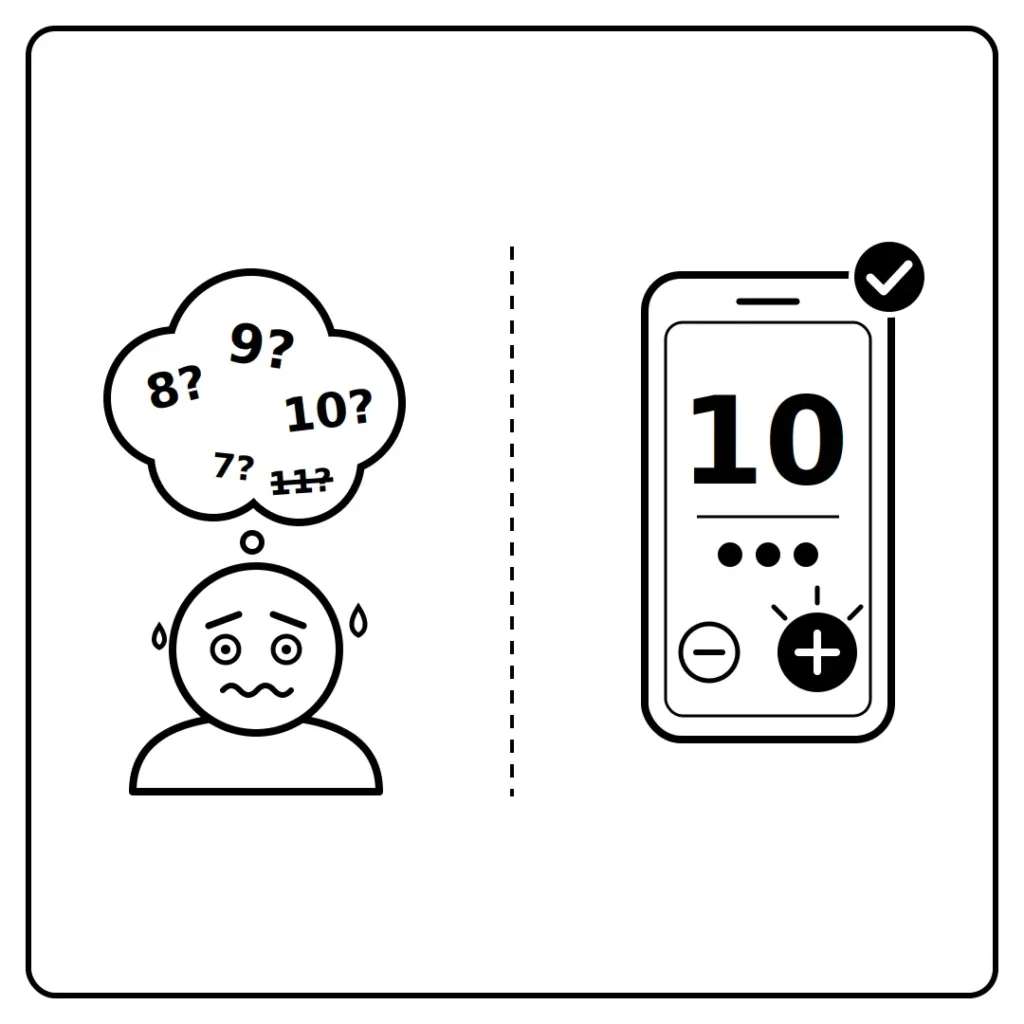
Early in a set, counting is easy. By the last few reps of a tough set, your focus shifts to finishing the movement, and the number gets fuzzy. Was that eight or nine? Most people round down and do an extra rep, or round up and cut the set short without realizing it.
Handing the count to a tool frees your attention for the things that actually affect results: controlled tempo, full range of motion, steady breathing.
Accurate numbers also make progress easier to see. If you did 3 sets of 10 last week and 3 sets of 12 this week, you’ve improved. That comparison only means something if both counts were right.
Rep Counter vs. Other Tracking Methods
|
Method |
Cost |
Setup |
Works best for |
Weak spot |
|---|---|---|---|---|
|
Online rep counter |
Free |
None, just open the page |
Counting reps and sets during a workout |
Not meant for long-term logging of weights |
|
Counting in your head |
Free |
None |
Short, easy sets |
Easy to lose track when fatigued |
|
Handheld clicker |
One-time purchase |
Buy and carry it |
Counting without a phone |
Tracks one number, no set tracking |
|
Pen and notebook |
Cheap |
Write after every set |
Keeping a paper record |
Eats into your rest time |
|
Workout log app |
Often free with paid upgrades |
Download and build routines |
Tracking weight and progress over months |
More setup than a quick count needs |
For counting in the moment, a free online rep counter is the quickest route. If you also want months of history and charts, pair it with a workout log you fill in after your session.
How Many Reps and Sets Should You Do?
The right number depends on what you’re training for, but you don’t have to guess. Two respected US sources offer clear starting points.
For General Health
The CDC recommends that adults do muscle-strengthening activities on at least two days each week, working the legs, hips, back, chest, abdomen, shoulders, and arms. Their guidance treats 8 to 12 repetitions of an exercise as one set. At least one set helps, and two or three sets bring added benefit. Work to the point where one more rep would be hard to finish without help. You can read the full breakdown on the CDC’s physical activity page for adults.
For Strength, Muscle, or Power
In 2026, the American College of Sports Medicine released updated resistance training guidelines, the first major revision since 2009. They offer targets based on your goal:
|
Goal |
Suggested approach |
|---|---|
|
Strength |
Heavier loads, around 80% of your one-rep max, for 2 to 3 sets per exercise |
|
Muscle growth |
Higher weekly volume, roughly 10 sets per muscle group |
|
Power |
Moderate loads, about 30% to 70% of your one-rep max, lifted as quickly as you can |
A few other takeaways from the ACSM update are worth knowing:
- Showing up consistently beats following a complicated program.
- Resistance bands, bodyweight exercises, and home workouts all produce real gains.
- Taking every set to complete failure isn’t necessary for most healthy adults.
The sets on a rep counter make those weekly volume targets easy to follow. Add up your sets for each muscle group, and you know whether you’re on track.
Where a Rep Counter Comes in Handy
A single counter covers straight sets of one movement. Once your session gets more complex, extra counters keep things clean:
Gym Workouts
Set your phone on a bench or the floor near the rack and tap between reps. On days with lots of exercises and accessory work, a rep counter at the gym keeps each movement’s numbers from blurring together.
Home and Bodyweight Training
Push-ups, sit-ups, burpees, squats, and lunges are all measured in reps. If you’re following a workout video, it’s especially easy to lose your own count while watching the screen. The counter keeps your number separate from what’s happening in the video.
Physical Therapy Exercises
Home exercise programs from a physical therapist usually spell out exact numbers, like 2 sets of 15 bridges. A counter helps you do what was prescribed, no more and no less. If your therapist’s plan differs from general guidelines, go with your therapist.
Circuits and Group Sessions
Running several stations? One counter per station keeps totals organized. Coaches and trainers can use the same setup to track a small group.
Tips for Counting Reps Accurately
Frequently Asked Questions
Start Rep Counting
Every good workout comes down to the reps and sets you actually complete. Counting them in your head works until fatigue kicks in, and then the numbers start to slip. A rep counter takes that job off your plate, so you can put your attention on form, effort, and getting through the set.
It’s free, it opens in seconds, and it works just as well in a crowded gym as it does in your living room. Scroll back to the top, tap the plus button on your first rep, and let the counter handle the rest.